Poisonous plants
Belladonna, foxglove, oleander, poison hemlock and castor bean can cause serious or fatal poisoning. Never experiment with them.

Traditional herbalism · Aromatherapy · Botanical education
Master Herbalist & Aromatherapist
Rooted in tradition. Inspired by the natural world.
Loading botanical library…
Arnica montana
Plant part: Flower
Traditionally used in external preparations
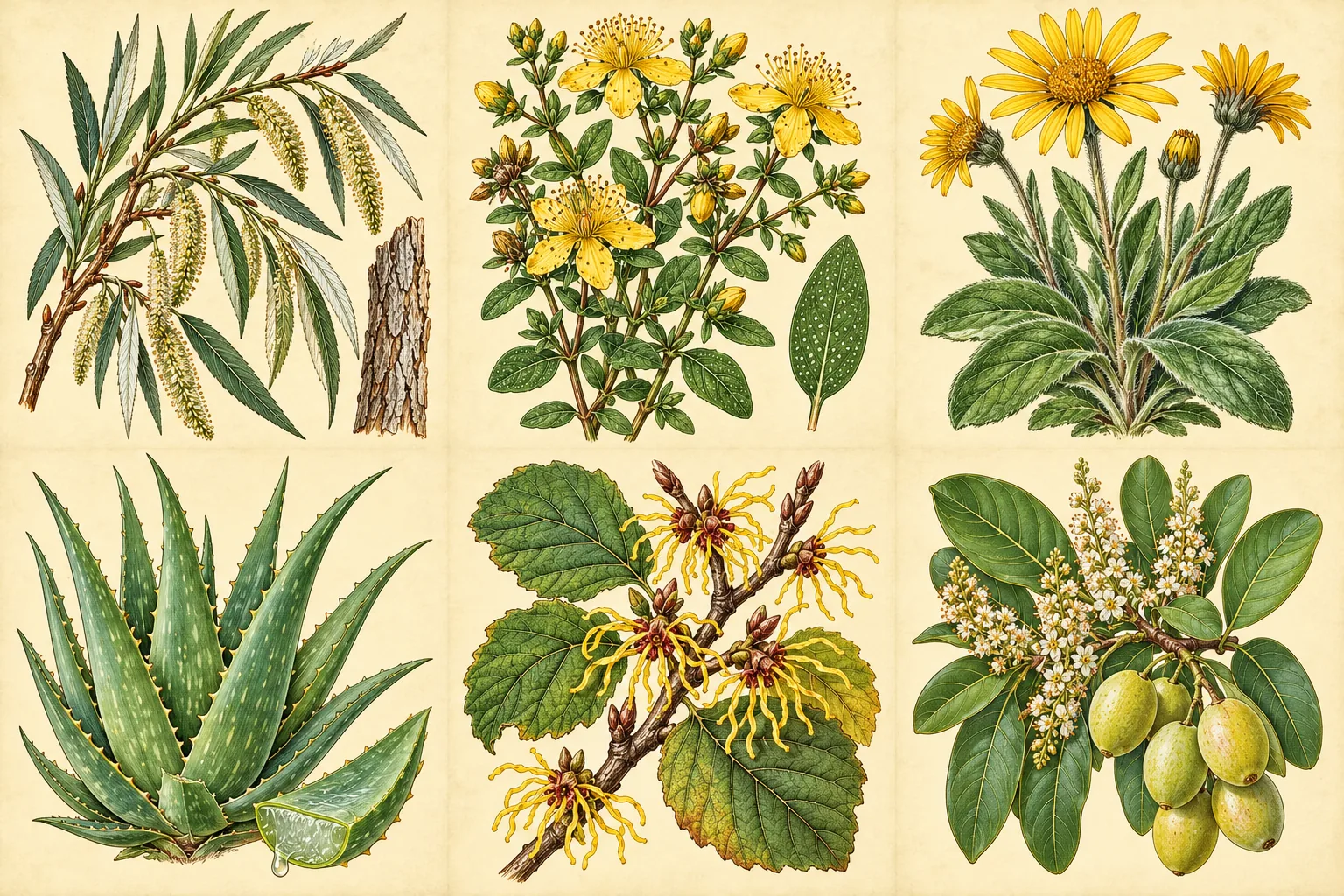
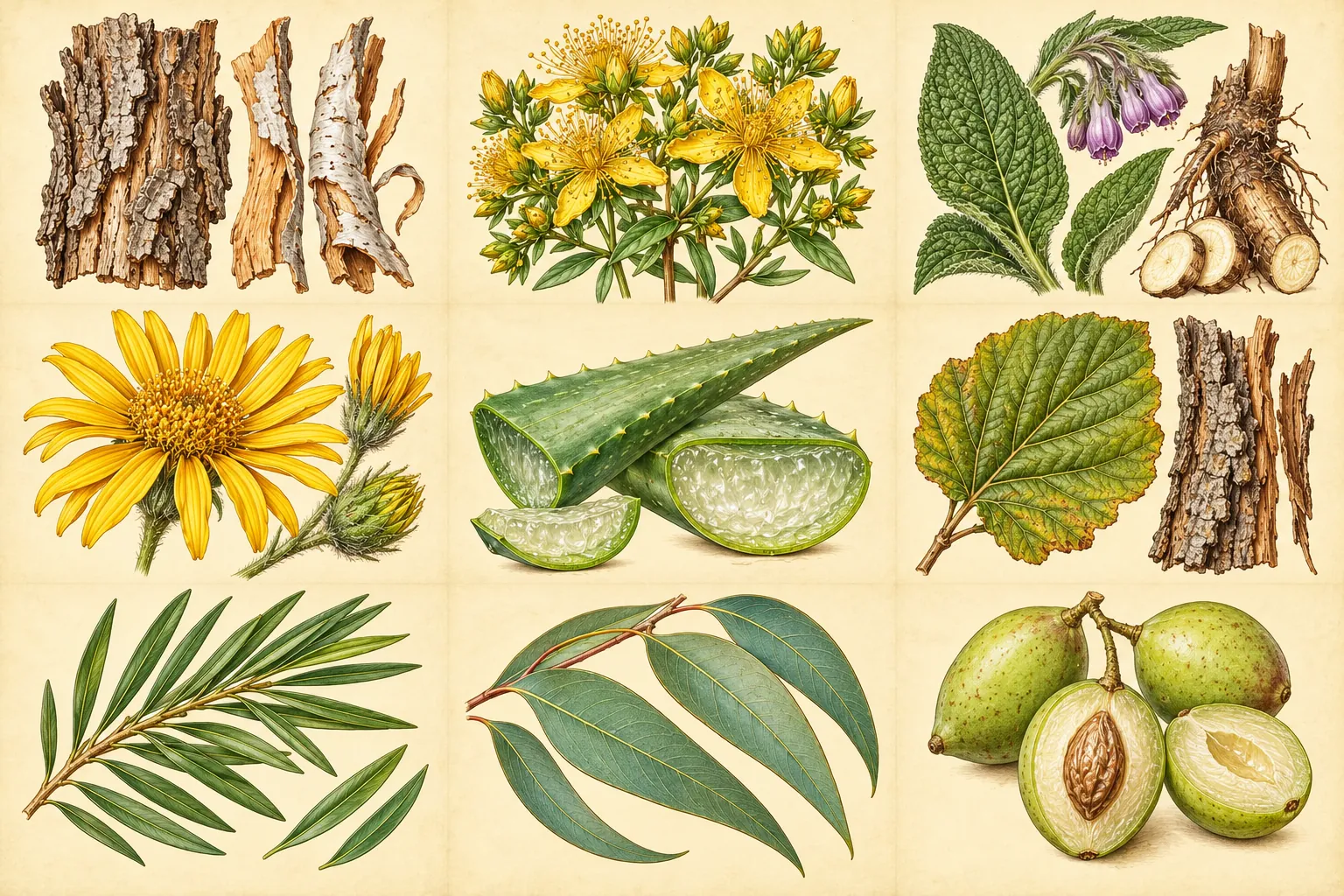
Arnica — Arnica montana. Arnica montana (Asteraceae) is a perennial with basal leaves, usually opposite stem leaves and yellow daisy-like flower heads. Flower is the recorded part. A yellow flower alone is not diagnostic; whole-plant characters and provenance are essential.
Arnica chamissonis may occur in some cultivated products but is a distinct species. “Mexican arnica” can refer to unrelated Heterotheca species and is not interchangeable. Leopard’s-bane ornamentals and other yellow daisies are lookalikes. A homeopathic product and a herbal extract also differ markedly in composition.
External arnica preparations have a European herbal tradition for bruising, sprains and minor muscle complaints on intact skin. Traditional use does not establish that a bruise has no fracture, bleeding disorder or other cause requiring assessment. Oral herbal use is not recommended.
Evidence for particular topical arnica products is mixed and formulation-specific. Highly diluted homeopathic preparations cannot be used as evidence for a concentrated herbal extract, or vice versa. This draft does not establish a safe internal dose or a general post-operative treatment.
Use only an appropriately labelled external product on intact skin when suitable. Do not ingest flowers, brew tea, take homemade tincture orally or prepare a concentrated extract. No homemade salve recipe or dilution is cleared here; a “natural” formula can still irritate or deliver an unsafe exposure. Follow the exact product label and stop if a rash develops.
No independently source-checked medicinal dose, preparation ratio, timing or homemade preparation shelf life is provided. Where a commercial product or established food recipe is mentioned, use its own instructions; forms are not interchangeable.
Do not ingest; avoid broken skin
Herbal arnica is toxic if swallowed. It can cause allergic contact dermatitis, especially in people sensitive to Asteraceae plants. Avoid broken skin, mucous membranes and eyes. Avoid medicinal use in pregnancy or breastfeeding without qualified advice; child use needs a product-specific assessment. Large, unexplained, worsening or persistent bruises and suspected fractures require medical care.
Mountain-herb and European household-remedy histories are often attached to arnica, but a specific regional spiritual account has not been checked. Do not claim that altitude, a folk name or a homeopathic tradition establishes clinical effectiveness.
A. montana generally requires an open, cool site and acidic, well-drained soil; it is not an easy substitute for ordinary garden daisies. Obtain propagated, correctly identified stock. Climate suitability and conservation rules need local checking.
Wild populations may be protected or vulnerable. Do not collect from conservation areas or substitute an unidentified yellow daisy. Cultivated flowers still require quality and identity checks; no home medicinal harvesting specification is supplied.
Keep any dried material clearly labelled “external use only” and separated from teas and food. Commercial topical products must be stored and discarded according to their own labels. Drying does not make ingestion safe.
Roots, stories & the aromatic cupboard
Come closer to the plants: the old household uses, the stories tucked into their names, the flowers carried for remembrance and the scents that mark a season.
Explore traditional herbalism, spiritual associations and botanical art at your own pace. Historical accounts, living beliefs and modern personal reflections are named for what they are. Research and references are there to unfold when you want a deeper look.
Meet the herbs · Explore the aromatic cupboard · Leave a topic for the herbalist
Sixty preserved herbal profiles and thirty detailed essential-oil drafts, prepared using the existing website and research. Botanical illustrations show the intended species for private review. They are AI-generated editorial drafts, not photographs or verified identification references. Original photo records and credits are preserved privately.
Launch library: 60 free herbs and 30 free essential oils. This preview contains the 60 launch herbs and 30 launch essential oils; the remaining original catalogue is retained in the project records.
Explore traditional herbal practices, plant parts and safety notes.
Aromatic profiles, botanicals and precautions.
Take or choose a photo, then open Google Lens yourself.
Poisonous plants, traditions and spiritual symbolism.
Browse 100+ herb entries and 50 essential oil entries. All 60 herbs in this preview have the established six-section educational draft. All 30 essential oils now have detailed expandable drafts, with preparation-specific evidence and safety boundaries. Research and photographic exceptions are recorded centrally. Search and favourites work offline while this page remains open. Reloading offline is not yet supported.
Search by common name, botanical name, plant part or traditional use.
Botanical identity, aroma and important safety precautions. Never ingest essential oils or apply them undiluted.
Choose a plant photo to preview here, then open Google Lens to explore a possible match. This website does not identify plants automatically.
Photo identification is fallible and must never be used alone to decide whether a plant is safe to ingest or use.
No photograph selected.
Your photo is used only for a temporary local preview. This website does not upload it, save it on a server or silently share it with Google.
The button opens Google Lens in a new tab. Your selected photo is not transferred. Choose or upload the same photo again in Google Lens. You can also open Lens without choosing a photo here.
Open Google Lens ↗Google Lens is Google’s service. If you choose to use it, Google handles information you provide under Google’s Privacy Policy.
Google may offer a browser upload, an app handoff or a sign-in prompt depending on your device and region. This site has no embedded Google identification API and does not receive Lens results. An internet connection is required for Google’s service.
Belladonna, foxglove, oleander, poison hemlock and castor bean can cause serious or fatal poisoning. Never experiment with them.
Keep oils away from children and pets. Dilution, age, pregnancy, medical conditions and medication interactions matter. Some citrus oils are phototoxic.
Historical and cultural use is not the same as clinical proof of safety or effectiveness. Consult qualified professionals for health decisions.
Lavender has been associated with peace, rosemary with remembrance, rose with love, and sage with purification in different traditions. These are cultural beliefs, not proven medical effects.
For suspected poisoning in Australia, call 13 11 26 (Poisons Information Centre). For an emergency, call 000.
Saved on this device in this browser.
All 60 prepared herb profiles, 30 detailed essential oil drafts, identification warnings and safety information in this preview are free. The launch target remains 60 free herbs and 30 oils; the remaining catalogue is retained, not deleted. Favourites stay on this device.
Additional species and cultivar comparisons are planned for AUD $7.95 monthly or AUD $80 yearly membership. Memberships, payments and subscriber access are not active. No payment or sign-in is required to use this site.
Essential safety and identification information will remain free. Unfinished research and photographs awaiting review are labelled throughout the library.
The shared reference library and safety information for Mother Nature’s Gifts. Botanical tradition, historical accounts and clinical evidence are different kinds of information.
This edition retains the website’s original research, but its external source queues have not yet been independently checked. Only sources actually consulted and verified belong in the bibliography below or a plant’s Sources list. Recommended reading is separate and is not claim support.
David Hoffmann’s Medical Herbalism is acknowledged as recommended reading, not as a book consulted for this revision. No passages, recipes or private photographs have been reproduced from it.
These are preserved overview excerpts and citation metadata, not a bibliography of full papers read or verified claim support. Original URLs and records are retained internally.
Eight retrieved NCCIH overviews have been read and compared with limited evidence and safety statements; they appear in the consulted-source bibliography. Their underlying clinical papers have not been read. The remaining links below are candidate authoritative reference/search leads, not verified citations. Detailed claim records remain private. No new medicinal quantities are source-cleared.
The government overviews listed as consulted were actually read or reused from an earlier documented consultation. They do not verify every oil, constituent, chemotype or safe use. Primary clinical papers and batch chemistry remain unchecked. Source-specific comparisons and all unresolved records are retained privately. No oral dose, numerical dilution or guaranteed child, pregnancy or pet-safe exposure is supplied.
Rose absolute is retained in the oil catalogue as a solvent-extracted aromatic material, distinguished from distilled rose oil. All additional oils, species and chemotypes remain planned subscriber material, not active paid access.
Individual source queues and claim/recipe records are retained separately for checking. Existing unverified sources are not treated as verified claim support. Preparation instructions that lack reliable support remain explicitly unavailable.
Original website material is retained. References identify sources; they do not grant permission to reproduce other authors’ writing or images. Private reference-book photographs are not reproduced here. Displayed private-review candidates retain supplied photographer, source and licence credits. Display is not verification or commercial-publication approval.
The existing branding artwork is retained from the original website. Its provenance and reuse rights still require confirmation before commercial publication.
Artwork, photograph credits and reuse permissions
These accounts document a named author, literary work or cultural context. They do not prove a universal belief, a medicinal effect, or ancient use of a modern essential oil. Modern personal reflections are identified separately. Detailed research findings and preserved earlier drafts remain in the private editorial records.
New sources were compared only for the recorded material, formulation and safety facts. Full cited books, clinical assessments, product stability and batch composition were not verified. Ingredient and recipe references are listed with their scope in the dilution guide and individual entries.
Explore the materials that carry aroma, soften a balm or give a formulation structure. A liquid oil, plant butter, animal fat and wax have different roles. These ingredient references describe cosmetic materials, not treatments or guarantees of suitability.
A percentage must state its basis. A 1% weight/weight (w/w) blend contains 1 g aromatic material in 100 g of finished blend, including 99 g base. A 1% volume/volume (v/v) blend contains 1 mL in 100 mL total. These are arithmetic definitions, not universal safe concentrations. Density means a millilitre is not necessarily a gram.
Choose the exact species, chemotype, extraction, application and user before considering a limit. Phototoxicity, irritation, sensitisation, constituent limits and the intended body site may require a lower concentration or make an oil unsuitable. A published maximum is a ceiling for its stated conditions, not a recommended starting point or assurance of safety. Ingredient limits can also apply to the combined contribution from several oils.
Aromatic material (g) = finished batch (g) × concentration (%) ÷ 100. Base (g) = finished batch − aromatic material. Add every component when checking that the formula totals 100%. Use an appropriate calibrated scale; tiny batches may require accuracy that a kitchen scale cannot provide. Do not improvise quantities below the scale’s resolution.
Dropper opening, angle, temperature, viscosity and oil density change a drop. There is no universal “20 drops = 1 mL” rule. The optional calculator uses a measured or hypothetical drop volume you provide; it cannot establish an oil-specific limit. Do not round a fractional drop upward and assume the concentration is unchanged.
All examples are adult cosmetic arithmetic only, for external use if separately justified. No oil-specific recipe is approved by this calculator. See each oil’s evidence and safety section and References & Disclaimer.
Simple anhydrous cosmetic preparations and clearly marked research gaps. Each recipe identifies its source, ingredients, quantities and precautions. A source-supported formula is not a tested finished product, a treatment or a guaranteed shelf life. No water-containing formulation or essential-oil ingestion recipe is supplied.
Future Angelic Keepah of Herbs products can link directly to these stable ingredient references. No shop, checkout, price or payment access is active.
Explore the ingredient-link demonstration
Links use #ingredient/ingredient-id and #profile/herb%3ACalendula. These routes can later be placed behind QR codes after an approved public address exists; this private preview is not a published QR destination.
Explore historical meanings, aromatic materials and practical distinctions alongside the existing profiles.
How people read resemblance, colour and plant habit as signs—and why those signs are not medical evidence.
A guide to attributed customs, modern symbolism and the difference between belief and measurable effects.
Useful distinctions for preparations, blending, carrier choice and evaluating old instructions.
How people read resemblance, colour and plant habit as signs—and why those signs are not medical evidence.
The Doctrine of Signatures is a historical way of interpreting nature: a plant’s form, colour, markings or behaviour was read as an indication of its relationship to a human organ, illness or need. A spotted leaf might recall a diseased lung; a red pigment might recall blood. The resemblance was meaningful within a worldview, rather than a measurement of pharmacological action.
“Doctrine” can suggest one agreed rulebook. Historical and ethnobotanical research instead finds overlapping explanations, local practices and later interpretations. A resemblance may have been a teaching aid for an already known use, an explanation added afterwards, or—in a particular author’s theory—a clue to discover a use. Those possibilities should not be collapsed into a single origin story.
In early modern European natural philosophy, the human body and the wider world could be understood as corresponding parts of a purposeful creation. Reading nature was therefore also an act of interpreting its maker. This could sit alongside practical observation, inherited recipes, humoral medicine and astrology; these were not interchangeable systems.
Paracelsus (1493–1541) is an important figure in the history of signature thinking and early modern medicine. Attribution needs care: writings circulated under his name after his death, and the authorship and dating of De natura rerum have been debated. It would be misleading to call him the proven inventor of every resemblance-based tradition. The 2021 historical review itself cites scholarship questioning that attribution.
Giambattista della Porta’s Phytognomonica (1588), Jakob Böhme’s seventeenth-century signature philosophy and William Coles’s The Art of Simpling (1656) illustrate later developments. They did not all mean exactly the same thing by a signature. These works are identified here through a consulted modern review, not presented as newly read primary editions.
A signature could be read in a whole plant or one organ. Root forms were compared with body parts; leaf outlines and markings with hearts, lungs or skin; red or yellow plant material with blood or jaundice. Habitat and movement also mattered: a root penetrating rock could be interpreted as a sign of power over stones, while a flower opening with sunlight could invite solar interpretation.
These are examples of historical reasoning, not directions for use. Yellow flowers do not diagnose or treat jaundice; a rock-growing plant is not a remedy for a kidney stone. Plants read as helpful signs may be toxic. The useful botanical exercise is to observe and describe what is actually present, then keep that observation separate from the historical meaning assigned to it.
Amots Dafni, Saleh Aqil Khatib and Guillermo Benítez · 2021 · Graeme Tobyn · 2024
The folded kernel of walnut, usually identified today as Juglans regia, is compared with a brain in Nigel Chaffey’s 2018 Plant Cuttings commentary. He explicitly describes the resulting belief about brain-related illnesses. This is a documented modern account of the analogy, not its earliest historical source.
The private verification register distinguishes that modern account from an authenticated early passage with a named writer and edition. Until an early passage is actually compared, this guide does not assign the story to Paracelsus, Coles or another author as an established fact. Nutritional or clinical research on walnuts would need its own assessment and could not prove the historical doctrine.
Pulmonaria officinalis has spotted leaves. Rachel Hajar’s 2013 history of medieval medicine describes their comparison with diseased lungs; a 2019 laboratory paper on this species also repeats the signature explanation. Those consulted secondary accounts document the example, while leaving the earliest author and precise transmission unresolved.
A laboratory investigation of an extract against bacterial isolates is not a clinical trial of lungwort for tuberculosis, cystic fibrosis or another lung disease. The plant’s resemblance supplies no reason to self-treat a respiratory illness, and no lungwort recipe is added here.
Rachel Hajar · 2013 · B. Sadowska, U. Wójcik, J. Krzyżanowska-Kowalczyk, M. Kowalczyk, A. Stochmal, J. Rywaniak, J. Burzyńska and B. Różalska · 2019
In an 1891 article in The Hospital, W. T. Fernie describes eyebright’s flower markings as resembling an eye and explicitly connects that reading with the doctrine of signatures. His name Euphrasia officinalis belongs to historical botanical usage; modern Euphrasia identification is more complex, so the passage should not authenticate every eyebright-labelled material.
This is evidence for a nineteenth-century writer’s account, not proof of the ancient origins he also alleges. His treatment assertions and preparations are not adopted. Nothing in a flower marking establishes that a home eye preparation is effective, sterile or safe.
The consulted 2021 review records heart-shaped leaves of Melissa officinalis in connection with a claimed heart-strengthening use, citing Ibn Sina and a modern informant. That supports a carefully scoped account for lemon balm; Ibn Sina’s original text was not independently checked. It does not prove a cardiac effect or make lemon balm a substitute for assessment of palpitations.
The owner’s lesson summary mentions pansies and heart symbolism, and houseleek and eye symbolism. These precise correspondences have not been authenticated in the sources compared here. Pansy’s name “heartsease”, a heart-shaped leaf, a historical medicinal use and a signature explanation are different propositions. No analogy from one plant is transferred to another. No houseleek juice or other plant preparation is recommended for eyes.
Graeme Tobyn’s 2024 study describes Culpeper’s “heart-trefoyl” and “pearly-trefoyl”: coloured leaf marks were associated with a heart and a pearl, with solar and lunar correspondences. The account demonstrates a seventeenth-century interpretive method. It does not settle those forms’ modern species identities.
For that reason, a trefoil story is not automatically inserted as a signature for the site’s Trifolium pratense profile. Likewise, historical mint, sage and cedar names cannot authenticate modern peppermint, clary sage or Atlas cedar. An oil requires another distinction: a plant story does not establish an ancient practice involving its concentrated modern extract.
A resemblance can aid memory, inspire art or help us understand a writer’s worldview. It cannot show absorption, dose, mechanism, clinical benefit, interactions, toxicity or the balance of benefit and harm. Nor does finding a bioactive compound retrospectively validate the whole doctrine.
Historical research asks who wrote the account, when, about which plant, in which edition and context. Clinical research asks a different set of questions about a defined preparation and measured outcomes. Respect for a tradition does not require treating these questions as the same. The existing profile cautions remain the starting point for any practical decision.
Amots Dafni, Saleh Aqil Khatib and Guillermo Benítez · 2021 · Paul Posadzki, Abdullah Alotaibi and Edzard Ernst · 2012
The linked herb and oil folklore sections retain their attributed stories and distinguish contemporary reflection. This guide is available from every profile for context; that link does not mean every plant has a documented signature. The private register records documented accounts, uncertain identities, common examples awaiting a passage and coursework-only statements separately.
Observe a leaf, sketch its pattern or compare a historical description with a botanical reference. Keep personal symbolism labelled as personal. Do not infer an edible plant, medicine or safe oil from a resemblance, a name, an illustration or an astrological correspondence.
Herbal library · Essential oils · Carrier oils and ingredients · All learning guides
A guide to attributed customs, modern symbolism and the difference between belief and measurable effects.
A documented historical tradition has a named source and a particular setting. A contemporary Western esoteric practice may deliberately combine older symbols into a new system. A personal belief may be meaningful without claiming shared inheritance. A scientific assertion needs independently assessable evidence about a defined effect.
These categories can coexist in one person’s experience, but should remain distinguishable in an educational guide. “I associate rose with kindness” is not the same claim as “all ancient cultures used rose to heal the heart”. The second needs historical evidence and should not be invented from the first.
Culpeper’s The English Physitian appeared in 1652 and an enlarged edition in 1653. Tobyn’s source comparison shows how planetary assignments and the language of sympathy and antipathy formed part of Culpeper’s medical philosophy, while much practical material drew on John Parkinson. It was an author’s system, not a universal botanical classification.
A planetary ruler, a zodiac sign and a modern birth-sign oil list are not equivalent. The coursework’s juniper/Pisces and peppermint/Taurus pairings remain unauthenticated here. No sign is used to select a medicine, determine a dilution or decide whether a person can safely use an oil.
Red can suggest blood, warmth or celebration; white might suggest purity, mourning or another meaning in a different setting. A colour’s meaning depends on the community, text, period and use. The 2021 signature review documents colour-based illness analogies, but that does not establish a universal colour-healing code.
Earth, air, fire and water belong to particular philosophical and esoteric systems. Their symbolic associations must not be confused with plant chemistry or oil flammability. A contemporary colour journal may record a personal response to a flower without claiming an inherited elemental correspondence or a measured biological effect.
The existing profiles use Richard Folkard’s 1884 collection and other specifically recorded literary sources. Folkard’s lavender accounts include fragrant linen and festive decoration; his flower-language tables even give differing meanings for lavender. That disagreement is informative rather than something to erase.
A collector’s report is evidence that the collector recorded an account, not that every person in a region shared it or that an older text he cites has been checked. A domestic custom, a poem, an amulet story and a treatment prescription need different descriptions. This guide does not turn any of them into instructions to burn plants, ingest oils or recreate a ceremony.
Crystal-and-oil pairings in contemporary spiritual practice may function as chosen symbols or ritual objects. No named primary source for a plant-specific crystal correspondence has been authenticated in this review, so no compulsory crystal table is supplied.
A decorative stone is not evidence of a healing mechanism and does not establish oil safety. Keep objects outside products rather than assuming they are suitable cosmetic ingredients or cleanable containers. Personal reflection can use an image, colour or written intention without placing stones in oils, drinking crystal water or attributing an unsupported medical effect.
“Aura”, “etheric body” and “astral body” describe concepts within spiritual and esoteric traditions. They are not established anatomical structures. A practitioner’s interpretation of an energy field should not be represented as a diagnosis or a demonstrated mechanism of healing.
NCCIH’s Reiki overview reports inconsistent, generally low-quality health research and no scientific evidence for the proposed energy field. Reiki is not identical to auric massage, so this is a boundary on energetic evidence, not a trial of every practice with energy terminology. Consent, touch preferences and the ability to decline scent matter independently of the spiritual explanation.
NCCIH · current page retrieved 2026-10-22; page last updated December 2018
“Grounding” can describe an ordinary act of noticing your surroundings; it can also mean something more specific in a spiritual system. State which meaning is intended. Looking at a botanical illustration, recalling a garden or writing about a scent memory can be an optional personal activity, without promising treatment for grief, trauma or depression.
Offer a fragrance-free option, accessible text and an easy way to stop. Do not insist on massage, a particular posture or deep breathing if uncomfortable. Persistent or severe distress needs appropriate professional support; spiritual language should not pressure someone to postpone that care.
Name the source, people or tradition when the evidence permits it, and make uncertainty visible without repeating editorial jargon in every paragraph. An outside observer’s report needs corroboration before being treated as community-authorised teaching.
No restricted or sacred ceremony, unsourced Indigenous plant ritual or generic “ancient wisdom” practice is taught here. Modern Western interpretation is labelled modern; individual reflection is labelled personal. Scientific evidence, botanical identification and permission to publish are separate questions from historical interest.
Herbal library · Essential oils · Carrier oils and ingredients · All learning guides
Useful distinctions for preparations, blending, carrier choice and evaluating old instructions.
A raw leaf, a food flavour, an infused carrier oil, a hydrosol, an essential oil and a formulated medicine are different materials. Check botanical identity, source part, extraction and supplier specification. Rose absolute is solvent-extracted; it is not interchangeable with steam-distilled rose otto. A botanical illustration cannot authenticate a bottle or a chemotype.
An Australian manufacturer’s product description is a manufacturer statement. A product’s formulation, directions and regulatory record cannot automatically be transferred to every generic oil with a similar name. This site has no doTERRA affiliation. Manufacturer comparisons remain private editorial records, separate from the independent references.
Smell can be closely linked with memory, preference and emotion, but “limbic” does not mean an oil switches off a disease or targets only unhealthy tissue. Context, personal history and expectation affect how an aroma is experienced.
NCCIH describes a study in which lemon scent improved mood without changing the measured stress, immune or pain indicators. That illustrates why a subjective benefit must not be inflated into an immune treatment. Evidence from a particular formulation, route or group of participants does not apply automatically to another product or person.
NCCIH · current page retrieved 2026-10-22; page last updated January 2020
Perfumery notes describe a material’s perceived role and persistence in a fragrance. Citrus is often described as bright and relatively fleeting; floral or herbal materials can bridge a composition; woody and resinous materials may provide more persistent character. Categories are approximate and depend on the particular extract and blend.
The oil profiles give editorial aroma pairings, not therapeutic combinations or tested formulations. No pairing establishes a safe concentration, pregnancy suitability, phototoxicity control or clinical benefit. A scent can be unpleasant or triggering to someone else even when you enjoy it.
Massage products need a suitable finished skin formulation. Perfumery needs assessment of fragrance ingredients and route. Aromatic household products must be appropriate for the setting and occupants; a diffuser is not a treatment for a respiratory infection. Cosmetic applications should not be described as treatment for eczema, burns or infection without suitable evidence.
Use the existing ingredient references to distinguish cold-pressed fixed oils, jojoba wax esters, fractionated coconut oil and calendula-infused oil. Maceration transfers selected plant components into a carrier; it does not manufacture an essential oil. An edible carrier does not make an essential oil edible. Nut allergy, supplier grade, oxidation and intended route still matter.
A concentration is meaningful only with its basis, material, intended route, exposure, user and formulation. A single percentage is not universally suitable for every oil, body site, child or pregnancy. The existing dilution calculator performs arithmetic; it does not select a permitted concentration.
Do not turn historical instructions for neat application, an unmeasured number of drops, oil on burns, or oil in plain bathwater into a modern recipe. Essential oils do not become evenly dispersed in water simply by stirring. A carrier oil is not itself a bath dispersant. No new formula or numerical oil dilution is approved in this update.
A 2012 systematic review’s abstract reports adverse effects ranging from dermatitis to severe events in published case reports. Case reports demonstrate that harm can occur; they cannot establish how frequently it occurs in the general population. This review’s full paper was not consulted here.
NCCIH records allergic skin reactions with lavender and tea tree products, possible coughing or headache with lavender aroma, and serious poisoning if tea tree oil is swallowed. Stop an exposure that causes irritation, wheeze or other symptoms and seek appropriate care. Breathing difficulty, seizure, severe allergic reaction or suspected poisoning requires urgent medical help. In Australia call 000 for an emergency, or 13 11 26 for the Poisons Information Centre.
Paul Posadzki, Abdullah Alotaibi and Edzard Ernst · 2012 · NCCIH · retrieved 2026-10-22 · NCCIH · retrieved 2026-10-22
No infant, pregnancy, breastfeeding or pet-safe exposure is established by a pleasant smell, a traditional reputation or a manufacturer’s general use list. Peppermint’s menthol is specifically unsuitable on or near young children’s faces because of possible breathing effects. Research on enteric-coated adult peppermint products does not authorise swallowing retail oil.
People with asthma, seizure disorders, depression or other serious conditions need preparation-specific advice and appropriate medical care. Fragrance may itself be a problem for some people. Massage or scent preferences can be discussed alongside care, without replacing prescribed treatment or claiming to cure an underlying condition.
Keep the material name, extraction, batch, opening date, quantities and intended application with any assessed preparation. Follow the supplier’s storage information; do not assign a universal home shelf life. Heat, light and air can change aromatic materials, and aged tea tree products may be more irritating.
Vitamin E can act as an antioxidant ingredient. It is not a substitute for an appropriate antimicrobial preservation strategy, contamination controls or stability assessment. Existing untested recipe drafts retain their status. Professional responsibilities include consent, honest marketing, clear records, referral and avoiding claims beyond one’s competence—not a promise that correct use eliminates every adverse effect.
Herbal library · Essential oils · Carrier oils and ingredients · All learning guides
Membership payments are not open yet. You can create an account, sign in and request a password reset.
Connecting to the private account service…
Use a unique passphrase of 12–128 characters. Verify your email before logging in.
Planned memberships: A$7.95 monthly or A$80 annually. Payments are not open yet.
Approval records your decision only. This service has no publication action. Check the actual sources before attesting.
Questions, notes and answers here stay private. “Answered” and “Added to Library” record your progress; they do not publish anything. Remove any accidentally submitted personal information with Delete.
A place for curiosity
Is there a plant you would love to meet, a fragrance you are curious about, or an old story you would like us to explore? Leave a topic in our herbalist’s basket.
We welcome requests for herbs, oils, varieties, folklore and educational guides. Requests stay private. Members’ requests may receive priority, but we cannot promise a personal reply or a particular completion date.
If you need help with your health, speak with a qualified health professional. For suspected poisoning in Australia, call 13 11 26; in an emergency, call 000.
Mother Nature's Gifts is operated by the registered business Angelic Keepah of Herbs.
© 2026 Angelic Keepah of Herbs. Mother Nature's Gifts — All rights reserved.
This notice applies where copyright subsists and to the rights held by the operator. It does not transfer ownership of third-party work or claim exclusive copyright over material generated entirely by AI.
The owner supplies the guide’s branding, editorial direction and review decisions. Human-authored writing and original human creative contributions remain subject to their applicable rights. The current draft also contains AI-assisted writing, organisation and software. A claim of human authorship is made only where that contribution is documented.
The botanical plant and parts illustrations are AI-generated editorial artwork. They are not photographs, verified identification plates or proof of a plant’s medicinal properties. No exclusive copyright is claimed in purely AI-generated material. Any human editing or arrangement is distinct from the underlying generated output.
The private preview retains the existing botanical artwork and vintage background. Its asset-by-asset provenance and commercial-use review are held in the private rights register. Artwork or background material whose permissions remain uncertain is not cleared for public release.
Earlier third-party photograph candidates and their supplied photographer and licence records are preserved privately. Unreviewed cached candidate photographs are withheld from this public-file bundle. A licence label supplied by an API does not by itself verify the photographer, exact licence version, permitted commercial use or depicted species.
Owner-uploaded photographs retain the photographer’s rights. Permission for a private preview does not automatically grant commercial publication rights. A photograph must have suitable permission and correct attribution before any future release.
Historical stories name the writer or source being discussed. Much of the current source-linked folklore draws on Richard Folkard’s Plant Lore, Legends, and Lyrics (1884), with literary context from Shakespeare’s Hamlet. A historical report is not proof of every event, community practice or medicinal belief it recounts.
Folkard transcription and its terms · Folger Shakespeare Library: Hamlet, Act 4, scene 5
Modern editions, translations, photographs and website material can have rights separate from an older underlying work. Source text and illustrations are not licensed for reuse merely because they can be viewed online. This guide does not grant a sublicence to third-party material.
Botanical and safety references include Kew Plants of the World Online, VicFlora, government and medical references linked within the guide. Source facts, quotations, historical beliefs, laboratory findings and clinical evidence have different scopes. Attribution does not imply endorsement or permission to copy the source’s artwork or prose.
The service uses Flask, Werkzeug and Gunicorn, alongside other open-source dependencies. Their individual licence notices remain applicable. Playwright is used for private testing. Third-party software is not claimed as the operator’s original work.
Please seek permission from the relevant rights holder before reusing protected writing, design, artwork or photographs. This credits page is a notice of scope, not a certification that unresolved rights or botanical checks have been completed.
Return to the herbalist’s garden · Sources and safety information